
NO. 101 | THE COMPLICATED RELATIONSHIP BETWEEN BEAUTY AND IDENTITY.
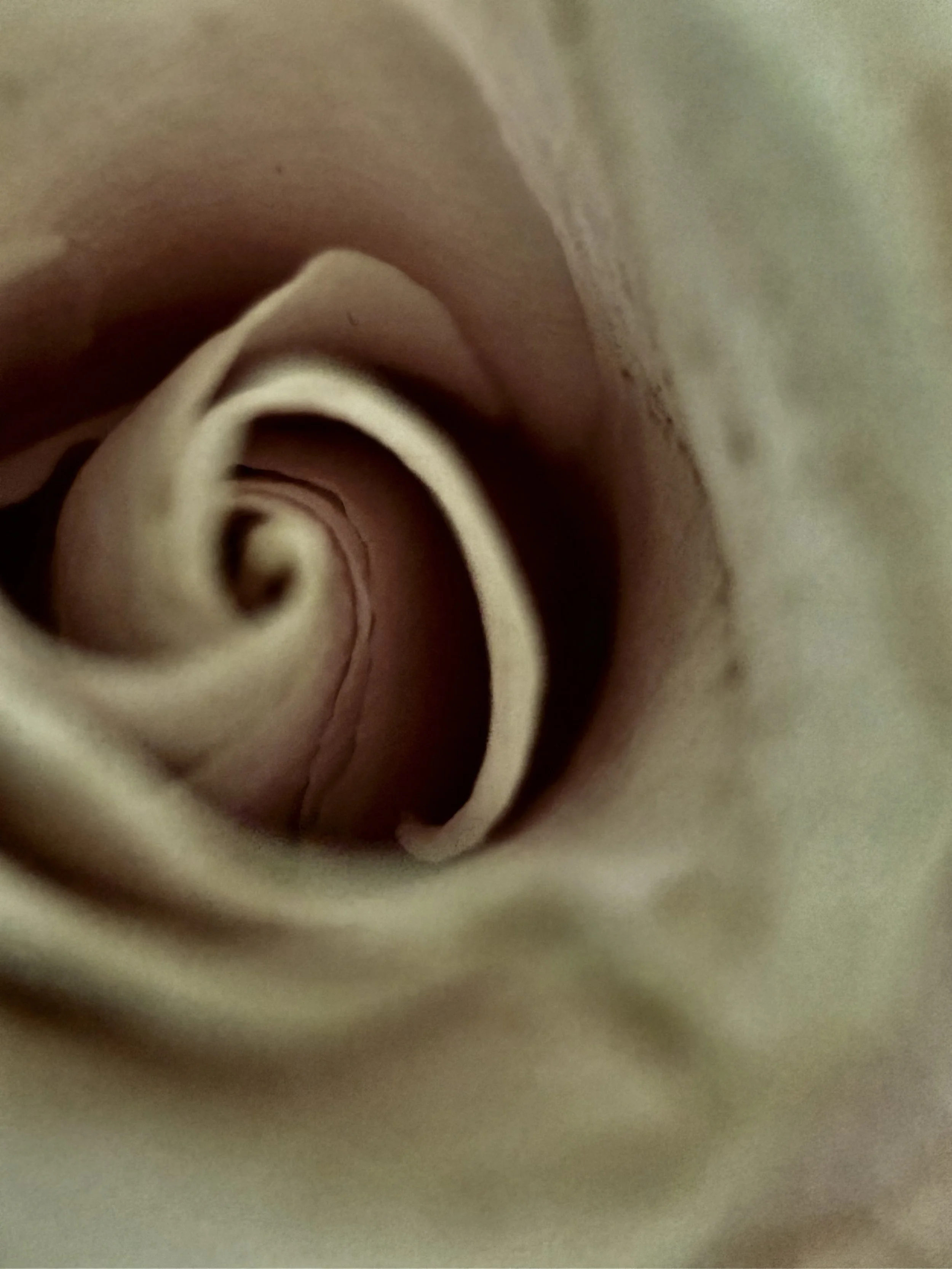
photograph by Michel Van Devender
I was that kid who spent hours rearranging her bedroom furniture, on the regular, completely lost in it that way you look up and realize the whole afternoon has evaporated. And I probably did it again the next day. I loved doing it that much. I grew up in Concord, North Carolina, and there was a stretch of downtown on Union Street where there was this two story antique and vintage store I loved. I think it was called 21 Union Street. I was perusing those stores long before vintage was a trend, way before anything called Granny Chic existed. That's where I found my first bedroom suite, art deco blonde wood and an original brass lava lamp I loved unreasonably, each night watching that amoeba-like blob contort and retort within the teal liquid substance. I was sixteen or seventeen. I wasn't following anything. I was just following something in myself that I didn't have language for yet.
What I was doing in that bedroom, I understand now, was creating a self. A space that was mine inside a house that belonged to everyone. The room where I did my homework and talked on the phone for hours and existed in the particular way teenagers need to exist, which is privately, on their own terms, surrounded by things that feel like them. I think that's why I believe so strongly that children need their own personal spaces. Not just a room, but a space they're allowed to make their own. Because there's something that happens when a person, even a young one, gets to say this is mine and it reflects who I am. Albeit a complicated belief to hold as an interior designer mother, but I stand by it.
I want to say upfront that I'm aware I'm not a neutral observer here. I have a beautiful home that I've spent years making feel like me. I have a decade in the design industry and a deep, lifelong relationship with beauty and space. Someone could reasonably ask whether this is just a person with a well-appointed home making a philosophical case for well-appointed homes. I'm going to write this anyway because I think the question underneath it is worth examining honestly regardless of where I land.
When I walk into a space that is beautifully done, I feel it in my body before I think it in my mind. There's an aliveness to it, or a peace, or a sense of being in the presence of a story being told through visual language. And when something is off, I feel that too. It may register as a visual dissonance of sorts or a spatial restlessness I can't always immediately name. I've come to understand that's not a superficial response. That's attunement, an alignment, like a musician who can tune an instrument by ear alone. The same nervous system that picks up on emotional undercurrents in a room full of people also picks up on proportion and light and texture and whether a space feels honest or performed. It's the same instrument responding to its environment. Highly sensitive people tend to experience this, the felt sense of beauty and its absence, as information rather than decoration. Though what feels harmonious to me might feel sterile to someone else, and what feels alive to me might feel overwhelming to another. Aesthetic sensitivity is real and it's also deeply personal. My first husband used to say I was the only person who could move a vase a millimeter and think it changed something. He wasn't wrong.
I spent many years working in the interior design industry, and what I learned there, alongside everything I've come to understand through years of clinical work as a psychotherapist, is that space affects us in ways most people don't examine and are often completely unaware of. The quality and quantity of light in a room. The scale of furniture relative to the space and the human body. The way we see, perceive and process our surroundings. These aren't only decorative concerns, they're psychological ones too. Humans have always known this on some level, even if they didn't have language for it. The earliest humans painted the walls of their caves. We are not separate from our environments, even when we think we are. We respond to them constantly, mostly without realizing it.
And what I've noticed, both in the design work and in the therapy room, is that people are affected by their spaces even when they have no awareness that they are. I've watched people walk into a beautifully considered space for the first time, people who have never lived that way, and something shifts in them almost immediately. They don't always have words for it. They just know something feels different. The space did something to their nervous system before their mind had a chance to have an opinion about it.The inverse is also true. People who live for years in environments that feel chaotic, oppressive or completely disconnected from who they are pay a real psychological cost. The home we create around ourselves is never just aesthetic. It's an ongoing act of self-definition, a way of saying this is who I am, this is what I value, this is what makes me feel most alive. And when that's absent, something in a person tends to know it.
I'll also say that I left the interior design industry eventually. The creative work I loved kept getting buried under sourcing and tracking orders and installs, and I found myself worn down by the relentlessness of the business back of house part. I also saw up close what it looks like when the relationship to beautiful things tips into anxiety, when a delayed delivery becomes a genuine crisis, when beauty becomes a transaction. I don't say that to judge it. As a psychotherapist I understand that the sofa is rarely really about the sofa. But I think part of what I was working out in leaving, and in writing this, is that somewhere along the way the industry's relationship to beautiful things started to color my own, and I started to wonder if my own love of it was somehow implicated. It wasn't. The interior designer in me never left. She just stopped working for clients. The love of beauty, of spaces that are collected over time and tell a story, of the ideation and the imagining of what a space could be, that part is still very much mine. I just needed to do it in a way that I actually enjoy.
That didn't happen overnight though. For years I judged myself for loving beautiful things. I've wondered whether caring about how a room feels is vanity, whether the hours I've spent making my spaces personal are somehow less serious than other ways of spending time. I think I internalized a message that exists pretty broadly in our culture, which is that beauty is acceptable in nature but suspect in objects. A flower or sunset is fine. A perfectly chosen sofa is questionable. A stunning room is showing off. You're materialistic, driven by consumerism, seduced by marketing. And maybe sometimes that's partially true. I hold that possibility about myself too. But there's a double standard in that thinking I haven't been able to resolve, because the capacity to feel beauty doesn't change based on what it's responding to. The attunement seems to be the same. What differs is whether culture has decided the thing is allowed to be beautiful. There's a version of this thinking that says a flower is acceptable because God made it. But didn't God also make the ingenious and creative people who make beautiful things? I've never been able to reconcile that double standard either.
There are philosophical and spiritual traditions that would push back on all of this, and I think they deserve honest consideration here too. The question most of them are actually asking isn't whether beauty is wrong. It's whether you're attached to things in a way that makes your peace dependent on having them, whether you could lose them and still be okay. That's a meaningful distinction. You can love a beautifully made object deeply and still not need it to be yourself. I've honestly wondered whether I need my house to be a certain way to be okay. I'm not entirely sure of the answer. It might be yes. Interestingly, Buddhism has one of the richest aesthetic traditions in the world. Wabi-sabi comes out of Japanese Buddhism, this idea that impermanence and imperfection aren't things to fix or mourn, but are actually where the beauty lives. Beauty and non-attachment aren't opposites in that tradition. You can be fully present with something beautiful precisely because you're not clinging to it.
I've spent a lot of time trying to draw the line between aesthetic sensitivity and status seeking, and I'm honestly not sure it exists as cleanly as I'd like. I'm drawn to certain things because something in their design is genuinely beautiful to me and completely unmoved by others that cost twice as much. But if I'm being fully honest, I can't always separate what I'm responding to aesthetically from what I've absorbed culturally about what certain things mean or signal. And I'm not sure anyone can. What does it say about you if you value expensive things or want a house that makes a certain impression? It depends enormously on what's underneath it and on how honest you're willing to be with yourself about the difference. The question worth asking isn't whether you're completely free of status seeking, because you're probably not and neither am I. The more useful question is whether you're aware of it, whether you can hold it with some curiosity rather than either defending it fiercely or condemning it.
My home is definitely part of my identity, not in a way I planned or decided, but in the way you notice something has always been true for you. Not as a status symbol or a performance for anyone looking in, but as an extension of who I am, the same way my paintings are, the same way this writing is. I still rearrange furniture and vignettes the way I did at sixteen on Hills Dell Drive. I make art here in my current house. I love my family here. For someone who is wired the way I am, as an artist, a designer, a psychotherapist, a person who feels everything in her nervous system before she thinks it in her mind, the home was never going to be just a backdrop. It holds my aesthetic and my history and my values, yes, but it also holds my creative life and the people I love most. It's where I'm most myself, not performing anything for anyone. That's what I mean when I say it's part of my identity. It always has been, from my childhood bedroom forward.
I think most of us construct some version of a philosophy that makes our own choices feel right and necessary. And I'm not sure that's something to apologize for, in myself or in anyone else.
And I imagine I'll always be having some sort of love affair with beauty. I still sometimes catch the old judgment in myself. But I've decided the questioning is part of what keeps it honest. And that's the space I want to live in.
xx,
Michel